Vancouver Braces for a Measles Warning

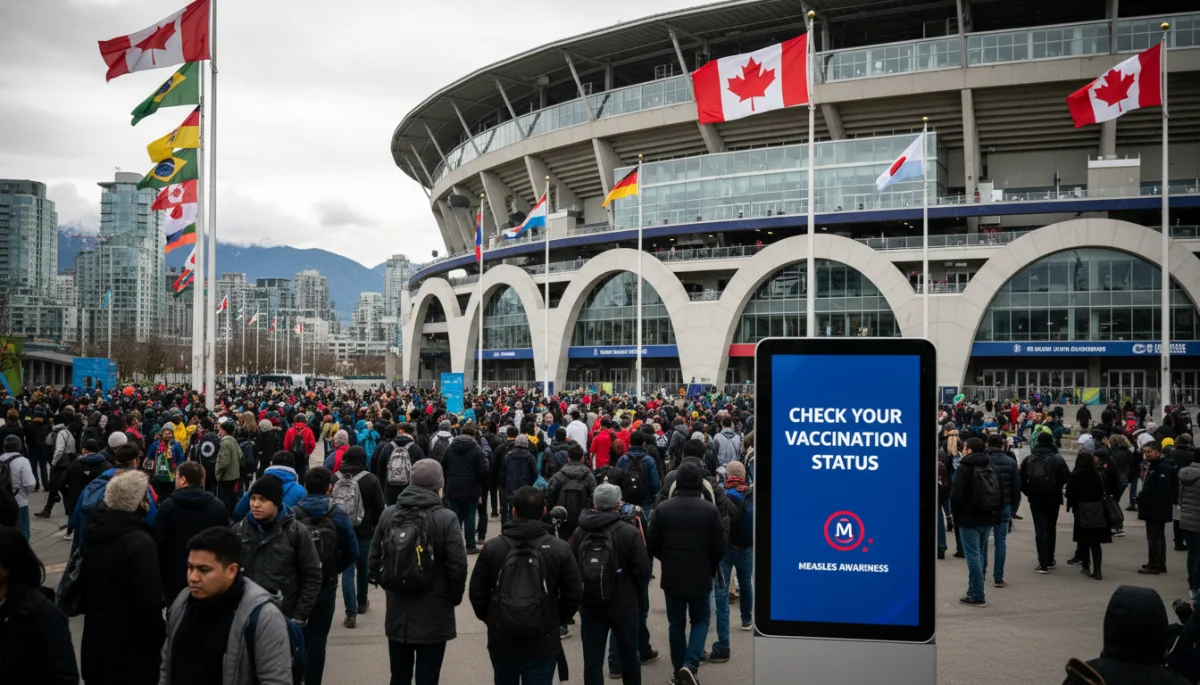
Health officials are watching the lead-up to the FIFA World Cup in Vancouver with growing attention, and measles is high on the list of concerns. As fans, teams, and media crews travel in from around the world, experts say the city could face imported cases of the virus during one of the largest sporting gatherings on the planet.
The Public Health Agency of Canada has already flagged measles as one of the diseases most likely to be brought into the country during the tournament. That warning is not based on fear alone. Measles is still circulating in many places globally, it spreads with unusual ease through the air, and major events create exactly the kind of close contact that can accelerate transmission.
Ontario has published a detailed risk assessment for the event, pointing to travel volume, crowded venues, and lower vaccination coverage as factors that could help the virus spread. British Columbia has not yet released a public version of its own assessment.
Why Public Health Leaders Want Earlier Messaging
Dr. Brian Conway, medical director of the Vancouver Infectious Diseases Centre, says the lack of visible public communication in British Columbia is a problem. In his view, residents and visitors should hear clear guidance well before the tournament begins.
He argues that people should check their measles protection now instead of waiting until stadiums fill up. That means confirming vaccination records, catching up on missed doses if needed, and making sure international visitors understand that Canada is still dealing with active measles transmission.
- Check your vaccination history before traveling.
- Make sure children and adults are up to date on routine immunization.
- Share prevention advice with visiting friends or family.
- Seek medical guidance early if symptoms appear after exposure.
For Conway, the issue is straightforward: once crowds arrive, it becomes much harder to slow down a preventable infection.
The Outbreak Is Not Just a Local Issue
Canada has already reported more than 900 measles cases across seven jurisdictions this year, with Alberta and Manitoba accounting for the largest share. That number matters because imported cases can quickly become part of a broader transmission chain when immunity gaps exist.
The present outbreak follows an even larger surge last year, when more than 5,000 people were infected. Public health officials believe that outbreak began with exposure outside the country and then spread after a case was introduced in New Brunswick in the fall of 2024.
British Columbia has also seen substantial activity. Provincial data shows 470 measles cases across 2025 and 2026, with about 80 percent centered in northeastern B.C., where vaccination rates are among the lowest in the province.
Lessons From Vancouver’s Olympic History
Experts are looking back at Vancouver’s past as a reminder that large international events can create unexpected health consequences. After the 2010 Winter Olympic Games, British Columbia recorded a measles outbreak that ultimately involved 82 confirmed cases.
The earlier outbreak does not prove that the World Cup will trigger the same result, but it does show how quickly a virus can take advantage of dense travel patterns, large crowds, and uneven immunization levels.
Conway says the current risk may be even more complicated because vaccination coverage has dropped in some parts of British Columbia. He also notes that some of the countries sending athletes and supporters may have lower protection rates as well, increasing the chance that an infected traveler arrives in Vancouver during the event.
What Health Authorities Say They Are Doing
Vancouver Coastal Health says planning has been underway for years. The health authority says it completed a public health risk assessment with the B.C. Centre for Disease Control, although the results have not been released publicly.
Dr. Mark Lysyshyn, deputy chief medical health officer with Vancouver Coastal Health, said the assessment placed the measles threat for the tournament in the moderate range. He also emphasized that the region has already managed dozens of imported measles cases during the current outbreak without seeing sustained spread in the community.
According to Lysyshyn, strong immunization coverage in the Vancouver Coastal Health region has helped block onward transmission. That, he said, makes it less likely that an imported case during the World Cup would become especially difficult to manage.
Key points from local planning
- Public health officials have been preparing for the tournament for several years.
- The region has experience handling imported measles cases.
- Local vaccination rates remain an important defense.
- Authorities say the overall risk is manageable with proper preparation.
The City Says Emergency Plans Are Ready
The City of Vancouver says it already has operational and emergency response plans in place for the World Cup. Officials say those plans are designed to address a wide range of public health and safety issues if they arise during the tournament.
That preparation is important because sporting events on this scale place pressure on transit, hospitals, crowd control systems, and public information channels all at once.
Who Faces the Biggest Risk
Dr. Monika Naus, a professor at the University of British Columbia’s School of Population and Public Health, says large international gatherings always carry some infectious disease risk. Even so, she says the danger to the general public is limited because most adults are already protected through vaccination or prior infection.
The more serious concern, she says, is what happens if measles reaches a community with lower vaccination coverage. In British Columbia, those communities are often geographically clustered, which makes targeted spread more likely once the virus is introduced.
That is why experts keep returning to the same message: the general population may be at low risk, but under-immunized pockets remain vulnerable.
Why Immunization Matters Before the First Match
The main takeaway from public health experts is simple. Before the tournament begins, people should confirm they are protected against measles. The virus is highly contagious, but it is also preventable through vaccination.
For a city preparing to host a global audience, the best defense is not panic. It is early communication, up-to-date immunization, and a clear understanding of how quickly one imported case can become a bigger problem in the wrong setting.
Vancouver is hoping for a successful World Cup. Health officials want to make sure it is also a safe one.