Inside the New World Cup Fantasy Experience

The official FIFA World Cup 2026 fantasy game has arrived with Aramco as a presenting partner, giving supporters a new way to follow the tournament and test their squad-building instincts. Players can assemble a 15-man roster, chase points across multiple ranking tracks, and try to outthink millions of other managers while the event unfolds across North America.

A Tournament Format Built for Decision-Makers
Success in this game depends on more than simply selecting famous names. Managers must balance star power, position depth, and the tournament’s evolving rules while staying inside a $100 million starting budget. The squad must include two goalkeepers, five defenders, five midfielders, and three forwards, so every slot matters. That challenge becomes even more interesting because player values stay fixed throughout the competition, which means early judgment calls carry lasting weight.
The game also limits how many players can come from one nation, with the group stage starting at a maximum of three from any single country. Transfers are open without restriction until the opening match on Thursday, 11 June, and managers will again receive unlimited moves before the Round of 32. Outside those windows, the usual transfer rules apply, which makes planning ahead essential. During live matchdays, users can adjust their captain and use bench substitutions to squeeze out extra points, while a set of five boosters adds another layer of strategy. Those chips include Wildcard, 12th Man, Maximum Captain, Qualification Booster, and a Mystery Booster that will be revealed before the Round of 32.
How Points Will Be Earned
The scoring system rewards a broad range of real-world action, which should appeal to fans who enjoy both statistics and tactical nuance. Minutes played, goals, assists, goals conceded, cards, own goals, penalties won or conceded, tackles, chances created, and shots on target all factor into the total. Players can also gain extra credit for scoring directly from free kicks, and the game includes a scouting bonus for low-owned picks who deliver big performances. If a player owned by fewer than 5% of managers scores more than four points in a match, that differential choice can become a major advantage.
That structure encourages managers to think beyond obvious superstars. A premium forward may deliver steady returns, but a well-timed defensive asset or an underused midfielder can be just as valuable if the underlying numbers support the pick. Because the format tracks so many different categories, a player does not need to score to matter. A full 90-minute appearance with defensive actions, set-piece involvement, or chance creation can be enough to separate a strong lineup from a merely popular one.
Big Names, Big Prices, Big Pressure
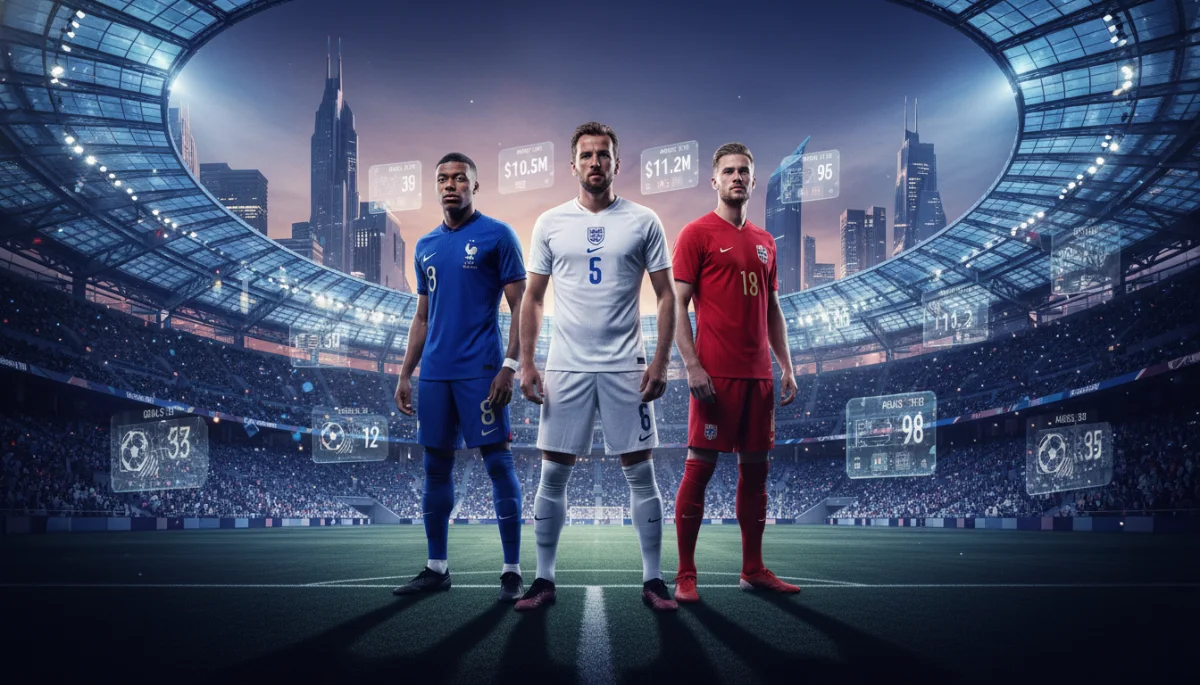
Pricing reflects the expected strength of the top nations, and the most expensive players sit near the top of the global hierarchy. Erling Haaland, Harry Kane, and Kylian Mbappé are the headline forwards at $10.5 million each, while Lionel Messi and Cristiano Ronaldo follow at $10 million. At the back, Portugal’s Nuno Mendes stands out as the costliest defender at $5.8 million. In goal, the premium tier includes Brazil’s Ederson and Alisson Becker along with Spain’s David Raya and Unai Simón.
The wider pricing model mirrors the FIFA/Coca-Cola Men’s World Ranking, which helps explain why the strongest football nations dominate the upper end of the market. Of the 25 priciest players in the game, 20 come from the top six countries in that ranking, and England and France each contribute five elite options. That concentration of talent means the most expensive picks will be familiar to most fans, but it also raises the difficulty of fitting a balanced lineup under the cap. The challenge is not just deciding who is best; it is deciding which premium names can be combined without weakening the rest of the squad.
Historical note: Kylian Mbappé won the adidas Golden Boot at FIFA World Cup Qatar 2022™, continuing a trophy tradition that began as the Golden Shoe in 1982 before the award took its current name in 2010.
Choices Beyond Europe
The new Confederation Challenge Leaderboard adds another strategic layer by measuring how different regions perform based on user selections. That makes value hunting outside Europe more important than it might first appear, especially for managers who want an edge in regional competition. In Africa, Mohamed Salah at $10 million and Omar Marmoush at $7.8 million headline the price list. In Asia, South Korea’s Son Heung-min at $7.4 million and Saudi Arabia’s Salem Al Dawsari at $7.2 million lead the way. Among the host nations in North America, Canada’s Jonathan David, Mexico’s Raúl Jiménez, and the United States’ Christian Pulisic are each priced at $7 million. Oceania’s premium option is New Zealand striker Chris Wood at $6.5 million, offering a solid route for managers seeking a different kind of squad balance.
That broader spread of options matters because fantasy success in a global tournament often comes from spotting value where others are still looking at name recognition. The best managers will probably mix obvious stars with carefully chosen regional picks, then use the unlimited early transfers to respond as the tournament begins to reveal which players and nations are in the strongest form.