Tuchel’s Bold Call Leaves England Unsettled

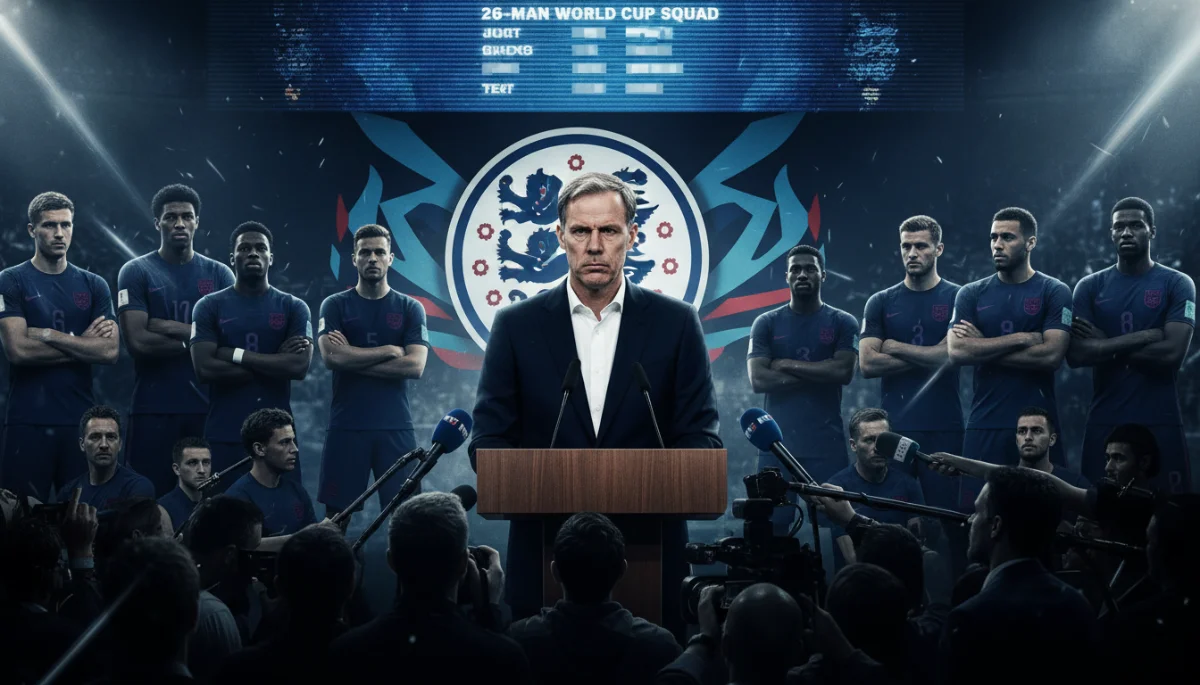
Thomas Tuchel has made his first major tournament selection for England a story built on shock, conviction, and consequence. His 26-man squad for the World Cup in North America arrived with several familiar names missing, and the announcement immediately sparked debate about whether he has been brave, ruthless, or simply willing to trust a different idea of balance.
Tuchel did not hide behind diplomatic language. He described the process as one he enjoys because it forces decisive choices, and the final list showed exactly that. A number of players who had seemed safe a few months ago were left out, while others who had not been certain of a place received a clear vote of confidence.
The biggest surprises in the squad
The most talked-about omissions are Cole Palmer, Phil Foden, Trent Alexander-Arnold, and Harry Maguire. Any one of those names would have been a major headline on its own, but seeing all four absent from the same squad made the announcement feel extraordinary.
Palmer and Foden stand out most because both have been viewed as essential attacking talents for England. Their club seasons, however, were not as strong as many expected, and Tuchel appears to have judged the competition for forward and creative roles as too crowded to carry both without compromise. In a squad with limited room, reputation alone was not enough.
Alexander-Arnold’s omission was perhaps less surprising but still significant. The Real Madrid defender has not been a regular in recent England camps, and that lack of momentum seems to have hurt him. Maguire’s absence, meanwhile, added to the sense that Tuchel was prepared to move away from a group that had defined England for years. Maguire himself said he was shocked and devastated, a reaction that reflected how unexpected the decision felt to many observers.
The scale of the reaction was captured by Sky Sports News chief reporter Kaveh Solhekol, who called it possibly the most surprising England squad since 1998. That comparison may sound dramatic, but it underlines just how unusual this selection felt from the moment it became public.
Fresh faces and a familiar striker
While the exclusions drew the loudest response, Tuchel also made a few eye-catching inclusions. The most notable is Ivan Toney, whose recall gives England another striker with a very different profile from Harry Kane. Toney’s physical style, directness, and penalty-box presence offer something that could prove useful if England need a plan B during the tournament.
Tuchel also showed trust in several younger or less-established players. Djed Spence, Kobbie Mainoo, Eberechi Eze, Noni Madueke, Jarell Quansah, and John Stones all found places in the final group, suggesting Tuchel wants a squad that mixes current form with long-term energy. The message is clear: he is not selecting only on past status, but on how players fit the team he wants to build.
Why Tuchel leaned this way
According to Tuchel, the selection process was emotionally difficult. He said he spoke directly with everyone involved in camp at least once, and many of the players who missed out had done enough to deserve serious consideration. That admission matters because it shows this was not a simple case of a few poor performances leading to obvious cuts. In many cases, the final decision seems to have come down to shape, timing, and what the coach believes the squad needs most.
He also pointed to the international windows in September, October, and November, when England looked stable and well organized. Tuchel clearly values the relationships and rhythm developed during that period, and he seems determined to carry that same core into the World Cup. Continuity, for him, may be worth more than chasing the hottest individual form at the last minute.
Another part of his thinking appears to be positional balance. Tuchel suggested that he did not want to overload the squad with too many players who do the same job, because that can force awkward tactical adjustments and leave some individuals out of their best roles. In that sense, the selection was not just about who was best, but about how each piece would fit into the larger structure.
Other players who missed out
Beyond the biggest-name absences, several other players with strong cases also found themselves outside the final 26. Morgan Gibbs-White, Adam Wharton, Lewis Hall, Luke Shaw, and Jarrod Bowen all missed out, despite bringing qualities England could have used in different circumstances.
That group of omissions reinforces the idea that Tuchel was making decisions with a specific tournament blueprint in mind. He did not simply pick the most popular or most in-form players available. Instead, he appears to have prioritized trust, tactical coherence, and the chemistry he believes can survive the pressure of a World Cup campaign.
The squad in full and what it suggests
England’s final group includes Jordan Pickford, Dean Henderson, and James Trafford in goal. The defense features Reece James, Ezri Konsa, Jarell Quansah, John Stones, Marc Guehi, Dan Burn, Nico O’Reilly, Djed Spence, and Tino Livramento. In midfield, Tuchel has gone with Declan Rice, Elliot Anderson, Kobbie Mainoo, Jordan Henderson, Morgan Rogers, Jude Bellingham, and Eberechi Eze. The forward options are Harry Kane, Ivan Toney, Ollie Watkins, Bukayo Saka, Marcus Rashford, Anthony Gordon, and Noni Madueke.
What stands out is not just the talent, but the variety. Tuchel has selected players who can stretch defenses, carry the ball, press aggressively, and adjust to different tactical demands. The group is neither the most conservative nor the most obvious version of England, and that is precisely why it has created so much discussion.
The real question now is whether this gamble will hold up once the tournament begins. Tuchel has chosen consistency over familiarity, flexibility over reputation, and a specific balance over popular expectation. If England go deep, the decisions will look visionary. If they struggle, the missing names will only grow louder.